


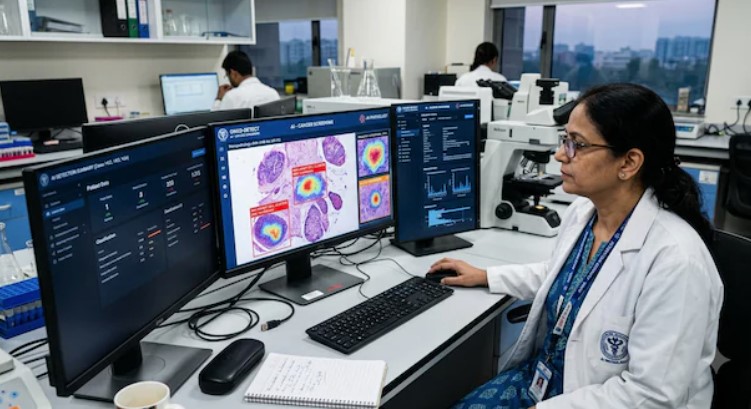
Indian researchers have developed MutAIverse, a generative AI platform that analyses DNA damage and traces possible chemical exposures behind it
Cancer diagnosis usually answers one crucial question: What kind of cancer does a person have? But Indian researchers are exploring another question that could be equally important: what might have triggered it? A team led by researchers at the Indraprastha Institute of Information Technology-Delhi (IIIT-Delhi), with collaborators including the National Institute of Pharmaceutical Education and Research (NIPER), Guwahati, CSIR-Institute of Genomics and Integrative Biology (CSIR-IGIB) and Dr Bhubaneswar Borooah Cancer Institute, has developed MutAIverse, a generative AI-powered platform designed to investigate the chemical exposures that may have contributed to DNA damage linked to cancer.
Published in the Journal of Cheminformatics, the study describes MutAIverse as a platform that can identify DNA adducts, chemical modifications formed when reactive substances bind to DNA, and then work backwards to identify their possible precursor chemicals or genotoxins.
The researchers tested the approach using tumour tissue from people with head and neck cancer and a history of smokeless tobacco use. However, experts caution that the technology cannot currently prove that a particular chemical caused an individual's cancer.
What Is MutAIverse And How Does It Work?
Cancer can develop when genetic changes accumulate in cells. Some of these changes arise randomly, while others can result from exposure to carcinogens, including certain chemicals in tobacco.
One way carcinogens can damage DNA is by forming DNA adducts. These occur when a reactive chemical or its metabolite attaches to a DNA molecule. If the damage is not properly repaired, it can potentially contribute to mutations and genomic instability.
MutAIverse is designed to study these molecular footprints.
The platform combines generative AI, chemical modelling and mass-spectrometry data to create a much larger reference library of potential DNA adducts. The researchers say the library expanded from fewer than 400 existing reference adducts to more than 300,000 potential structures.
Its AdductLinker component then attempts to work backwards from an observed DNA adduct to the chemical or genotoxin that could have produced it. The researchers describe this as a form of molecular backtracking: instead of simply detecting DNA damage, the system tries to identify what exposure could have left that particular molecular footprint.
What Did The Researchers Find?
The team applied MutAIverse to DNA adductomics data generated from tissue biopsies of head and neck cancer patients with a history of smokeless tobacco use. The researchers detected both known and previously unreported potential DNA adducts, with some findings subsequently validated using tandem mass spectrometry (MS/MS). The study also found DNA adducts that were enriched in tumour tissue and used AdductLinker to identify possible parent genotoxins.
This is particularly relevant in India, where smokeless tobacco products such as khaini, gutkha, zarda and tobacco-containing betel quid are widely used. WHO estimates that nearly 267 million adults aged 15 and above in India used tobacco according to the 2016-17 Global Adult Tobacco Survey, with smokeless tobacco being the most prevalent form.
Smokeless tobacco is an established carcinogen. IARC has concluded that it causes oral, oesophageal and pancreatic cancers, while WHO notes that it contains multiple cancer-causing substances.
Can The AI Actually Tell What Caused Someone's Cancer?
Not yet. And this distinction is important. Finding a DNA adduct demonstrates that a chemical has interacted with DNA. It does not automatically establish that the damage caused a mutation, that the mutation caused the cancer, or that the particular exposure was solely responsible.
Cells can repair some forms of DNA damage, while unrepaired damage can potentially contribute to genomic instability. The study itself describes MutAIverse as a research platform rather than a clinically validated diagnostic test. Independent experts cited in the news report also cautioned that additional experimental, clinical and epidemiological evidence is needed to establish a causal relationship.
This means a result suggesting exposure to a particular carcinogen should not be interpreted as proof of why an individual developed cancer.
Why Could This Matter For Cancer Prevention?
If further validated, technology like MutAIverse could add a new dimension to cancer research: moving beyond asking what mutations are present to investigating what environmental exposures may have contributed to them. That could potentially help researchers identify previously under-recognised carcinogens, understand cancer patterns in particular communities and identify preventable exposures.
This is especially relevant for India, where tobacco remains a major public-health concern. WHO says tobacco use contributes to nearly 1.35 million deaths annually in India and is a major risk factor for cancer and other chronic diseases.
IARC research has also shown how tobacco exposure can leave distinct mutational effects in head and neck cancers, strengthening the scientific rationale for studying the molecular footprints of carcinogens.
What Happens Next?
The researchers say MutAIverse could eventually complement other approaches, including genome sequencing and cancer genomics, to build a more complete picture of how cancers develop.
But before such a platform can influence patient care, it needs substantially more validation across larger and more diverse patient populations, different cancer types and a wider range of environmental exposures.
The technology therefore represents an important research advance, rather than a new cancer diagnostic available in hospitals today.


comments


Other categories
Recent Comments