


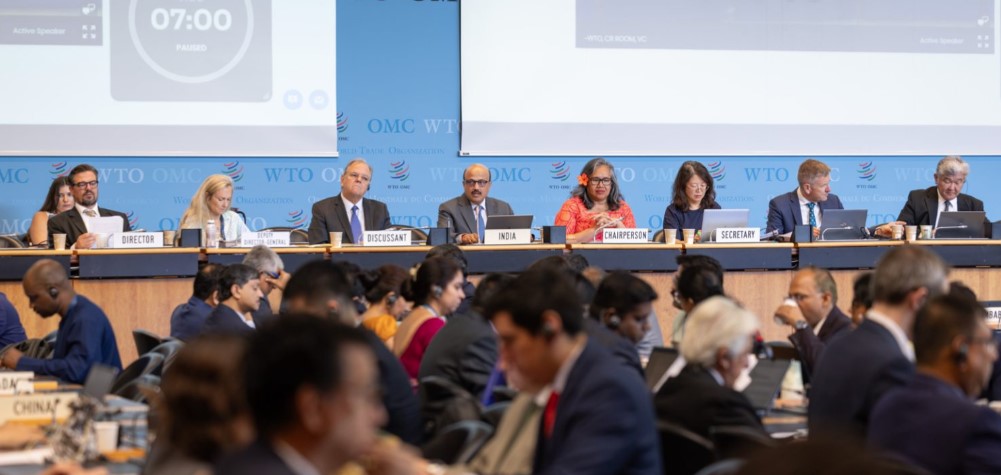
India on Thursday successfully concluded its Eighth Trade Policy Review (TPR) at the World Trade Organization (WTO) in Geneva, reaffirming its commitment to an open, transparent and WTO-consistent trade and investment regime while highlighting the country’s expanding role in the global economy.
The second and final session of the review, a key WTO transparency and monitoring mechanism under which members’ trade and related policies are periodically examined, witnessed active participation from WTO members reflecting growing international interest in India’s economic transformation.
India’s delegation was led by Commerce Secretary Rajesh Agarwal, who, in his closing statement, thanked WTO members for their active participation and constructive engagement during the review process. He said reform remains a continuous process and reaffirmed India’s commitment to maintaining an open, transparent and predictable trade and investment environment.
The Commerce Secretary highlighted that India’s tariff reforms, customs simplification measures and ambitious Free Trade Agreement (FTA) strategy have strengthened the country’s integration with the global economy while supporting domestic development objectives. He also described India as a major engine of global demand.
Responding to issues raised during the review, Agarwal said India’s trade policies are guided by WTO-consistent principles while balancing the developmental needs of a large developing economy. He noted that India’s agricultural tariff structure seeks to protect the livelihoods of millions of small, low-income and resource-poor farmers, while industrial tariffs are aimed at strengthening supply chain resilience, diversification and domestic manufacturing capabilities.
India received 1,094 written questions from 44 WTO members during the review. Over the two review sessions held on July 21 and 23, 68 WTO members made interventions, underscoring the strong global interest in India’s trade policies and economic reforms.
Several members appreciated India’s economic resilience and constructive engagement in the multilateral trading system. They also highlighted India’s achievements in Digital Public Infrastructure, customs and trade facilitation modernisation, innovation and startup initiatives, expansion of regional trade agreements and efforts to integrate micro, small and medium enterprises (MSMEs) into global value chains. Members also welcomed India’s acceptance of the WTO Agreement on Fisheries Subsidies.
On sanitary and phytosanitary measures, technical regulations and trade remedies, the Commerce Secretary reaffirmed India’s commitment to transparency, stakeholder consultations and adherence to WTO rules. He said India’s Quality Control Orders are intended to achieve legitimate public policy objectives, while trade remedy investigations are conducted transparently based on objective evidence, due process and judicial oversight. He added that the overall trade coverage of India’s trade remedy measures remains limited and that India continues to apply the Lesser Duty Rule in its anti-dumping framework.
The Commerce Secretary also outlined India’s efforts to promote sustainable development, women’s economic empowerment, digital public infrastructure, intellectual property reforms, services trade, investment facilitation and ease of doing business. He highlighted progress in financial inclusion, digital commerce, logistics modernisation and environmental sustainability, reaffirming India’s commitment to inclusive and innovation-driven growth.
On WTO reform, Agarwal reiterated India’s support for an open, inclusive, transparent and rules-based multilateral trading system. He said WTO reforms should remain development-oriented, preserve policy space for developing countries, strengthen the organisation’s credibility and deliver on existing mandates. He also reaffirmed India’s commitment to engaging constructively with all members to strengthen the multilateral trading system while preserving the WTO’s foundational principles.
The Commerce Secretary thanked Ambassador Nella Pepe Tavita-Levy of Samoa, Chair of the Trade Policy Review Body, Ambassador Guilherme de Aguiar Patriota of Brazil, who served as the Discussant, the WTO Secretariat, WTO members and Indian teams in Geneva and New Delhi for their contributions to the successful completion of the review.
Concluding the proceedings, Agarwal reaffirmed India’s commitment to transparency, dialogue and constructive engagement within the WTO. Invoking the Indian philosophy of “Vasudhaiva Kutumbakam” (the world is one family), he said India would continue working with all members to ensure international trade remains a force for shared prosperity, inclusive growth and sustainable development.
In his closing remarks, Ambassador Guilherme de Aguiar Patriota observed that amid heightened global uncertainty, many WTO members expected India to continue acting as a bridge-builder by promoting dialogue, fostering consensus and strengthening a rules-based, inclusive and resilient multilateral trading system. He also described India as a leading voice of the Global South with an important role in bridging differences among WTO members.
Chair of the Trade Policy Review Body Ambassador Nella Pepe Tavita-Levy noted that WTO members widely recognised India’s growing importance in the global economy and its expanding role as a driver of global growth and trade, while expressing hope that concerns raised during the review would be addressed appropriately.
India’s Eighth Trade Policy Review concluded on a positive note, underscoring the country’s increasing significance in the multilateral trading system and reinforcing expectations that it will continue to play a central role in shaping the future of the rules-based global trading framework.


comments


Other categories
Recent Comments