


Many earthquakes in Venezuela are "shallow-focus," meaning they occur less than 15 to 20 kilometres below the ground.
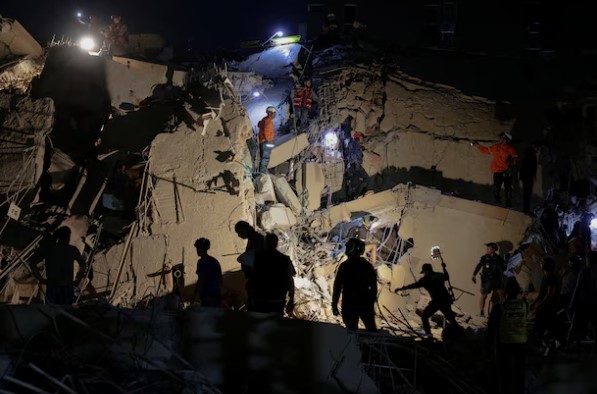
Venezuela on Wednesday night declared a state of emergency after two powerful earthquakes - magnitude 7.2 and 7.5 - hit the country within a span of 39 seconds and left behind a trail of widespread damage. Buildings collapsed, roof crumbled and people were left scrambling for safe shelter. As emergency crews continue to work round the clock to rescue people, global monitoring agencies have painted a grim picture.
The United States Geological Survey (USGS) warned that "high casualties and extensive damage are probable." Adding to the gravity of the situation, US President Donald Trump remarked that these quakes, some of the strongest the region has seen in over a century, have caused "a devastating number of deaths."
According to the latest USGS assessments, there is a 39 percent probability that fatalities could be anywhere between 1,000 and 10,000, and a 37 percent chance they could even touch 1,00,000.
Many Venezuelans were at home when the earthquakes struck because Wednesday was a public holiday marking a decisive 1821 battle in Venezuela's war of independence from Spain.
The twin earthquakes originated in Yaracuy state, west of Caracas, according to the USGS. The first, a magnitude 7.2 quake, struck at a depth of 22 km (14 miles), followed less than a minute later by an even larger magnitude 7.5 earthquake at a depth of about 10 km (6 miles).
Major earthquakes struck Venezuela, Japan, and California within just hours of each other, making people around the world wonder if these events are somehow connected.
The Tectonic Tug-Of-War In Venezuela
To understand why Venezuela was hit so hard, we have to look at its geography. Venezuela sits on the northern coast of South America. While most of its mainland rests safely on the South American Plate, its northern coast and offshore Caribbean islands sit right on top of a highly active boundary where the Caribbean and South American plates meet and grind past each other.
This complex tectonic setting puts the Earth's crust under constant stress. In fact, approximately 80 per cent of Venezuela's population lives in these active seismic zones, putting a huge number of people at direct risk.
This immense underground pressure is usually released along major fault systems, such as the Bocono Fault, which is notorious for triggering powerful earthquakes. To give you an idea of the movement, the Caribbean plate shifts eastward by about 20 millimetres every year compared to the South American plate. Researchers have found that a single slipping fault on the nearby island of Trinidad handles about 70 per cent of this intense motion.
The Hidden Danger Of "Shallow" Earthquakes
Another reason the tremors in Venezuela are so destructive is their depth. Many quakes here are "shallow-focus," meaning they occur less than 15 to 20 kilometres below the ground. A shallow earthquake is far more dangerous at the surface than a deeper one of the exact same magnitude. Because the quake happens so close to our feet, the destructive seismic energy doesn't have enough time or distance to weaken before it hits cities and towns.
What Causes An Earthquake?
Whenever we hear about earthquakes, we hear about "plates." Our Earth's solid outer crust is actually broken up into massive slabs of rock called tectonic plates (there are 15 major and minor ones). These huge plates float on a semi-fluid, incredibly hot layer of rock beneath them known as the mantle.
These plates don't just sit still; they are constantly shifting, bumping into each other, and pulling apart. It is this slow but incredibly powerful movement that creates spectacular mountains over millions of years and also triggers violent geological events like earthquakes and volcanic eruptions.
The Pacific Ring: The World's Most Active Zone
If you look at global earthquake trends, one region stands out: the circum-Pacific seismic belt. Found along the rim of the Pacific Ocean, this belt is responsible for about 81 per cent of the world's largest earthquakes.
Why Is It So Active?
This belt perfectly aligns with the boundaries of tectonic plates where oceanic crust is actively sinking (or subducting) beneath other plates. The slipping and rupturing of these massive rocks cause intense earthquakes. Some of the most historic tremors, like the magnitude 9.5 Chilean Earthquake in 1960 and the magnitude 9.2 Alaska Earthquake in 1964, occurred right here in this subduction zone.
A Look Back At Devastating Global Quakes
Nature's fury has left deep scars on our planet, especially over the last two decades. Here is a sobering reminder of some of the deadliest earthquakes in recent history:
- Turkiye and Syria (February 2023): A massive magnitude 7.8 earthquake in southern Turkiye claimed over 55,000 lives and flattened entire cities.
- Nepal (April 2015): A magnitude 7.3 quake shook our neighbouring country, killing approximately 9,000 people and causing tremors that were strongly felt across northern India.
- Japan (March 2011): The terrifying 9.0-9.1 magnitude Tohoku earthquake triggered a towering tsunami that hit northeastern Japan. It killed over 18,000 people and caused the infamous Fukushima nuclear disaster.
- Haiti (January 2010): A devastating magnitude 7.0 quake struck near the capital, claiming an estimated 2,22,570 lives and injuring 3,00,000 more, making it the deadliest natural disaster of the 21st century.
- Indonesia (December 2004): A colossal magnitude 9.1 earthquake off the coast of Sumatra triggered the deadly Indian Ocean tsunami. Over two lakh (2,27,900) people across several countries, including India lost their lives.


comments


Other categories
Recent Comments