


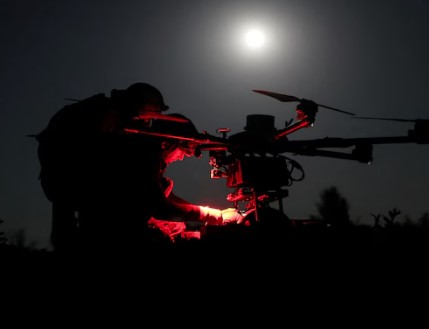
According to the report, drones have increasingly taken over the sniper's roles of reconnaissance and targeted killing. Their ability to provide a wider visual range, move maneuverability and carry explosives has made them more efficient in many combat situations.
Kovalskiy reportedly has not gone out on a shooting mission for over a year and a half. In several deployments during 2024, he failed to register a confirmed hit as Russian troops adapted to the growing drone threat by improving camouflage and concealment tactics.
He now mainly helps drone teams transport equipment, attach explosives to drones and assist with navigation during operations.
The report said drones have also reduced the importance of artillery spotters and weakened the battlefield dominance once associated with tanks, which have become frequent aerial targets.
A Ukrainian sniper with the call sign Ivanhoe told the publication that in 2022, sniper teams would detect enemy movement from long distances and relay coordinates for artillery strikes, a process that could take several minutes.
“Now, the drone operator sees it, the strike follows almost instantly,” he said. Ivanhoe has since become a drone operator himself.
Snipers also face rising risks on the battlefield due to drones equipped with thermal imaging systems that can detect body heat, which makes concealment more difficult.
Still, some military officials insist snipers continue to play an important role. A Pentagon spokesperson told the newspaper that the US Army is continuing sniper training while updating programmes to account for the widespread use of drones.
“The human sniper (is) a critical, unjammable, zero-signature asset on the modern battlefield,” Lt Col Vonnie L Wright said.
A Ukrainian sniper commander identified by the call sign Coyote said snipers remain useful in infantry operations, including targeting Russian soldiers who infiltrate behind Ukrainian lines and operating in weather conditions where drones struggle.