


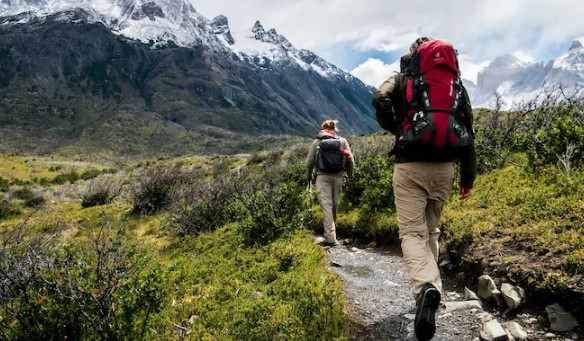
A 33-year-old woman's boyfriend was convicted of gross negligent manslaughter for abandoning her on Austria's tallest peak, Grossglockner
Picture this: you are halfway through a difficult mountain trail with your partner. The air is thinner, your legs are burning, and the path ahead feels unfamiliar. You slow down for a moment, expecting the person who supposedly loves you to wait, help, or even just turn around and check if you are okay.
Instead, they keep walking.
Soon, they are out of sight.
Your water is with them. Your phone signal is weak. You are alone in a remote landscape where a wrong turn can quickly become dangerous. And somewhere between panic, exhaustion, and disbelief, another thought begins to settle in: why would someone who cares about you leave you behind like this?
That unsettling scenario is now being discussed across social media under a term many people had never heard before: "alpine divorce".
The phrase has exploded across TikTok, Instagram, Reddit, and X in recent months, as women share stories of being abandoned during hikes, treks, and mountain expeditions by the very partners who invited them there in the first place.
And the renewed conversation began after one deeply tragic case.
The Case That Reignited The Conversation
This is exactly what happened to 33-year-old Kerstin Gurtner, whose boyfriend, 37-year-old Thomas Plamberger, was recently found guilty of gross negligent manslaughter after leaving her behind on Austria's Grossglockner mountain, the country's tallest peak.
The couple had been hiking near the summit in January 2025 when, according to Plamberger, Gurtner became exhausted. He later told the court that they decided he would descend the mountain to seek help while she stayed behind.
She froze to death.
Her body was discovered the following morning just metres below the summit.
The case quickly became international news, not just because of the tragedy itself, but because prosecutors argued that Plamberger failed to properly seek help despite having a phone signal. Rescue services reportedly struggled to reach him, and prosecutors accused him of delaying distress calls.
Judge Norbert Hofer, who presided over the case, acknowledged Plamberger's grief but criticised his actions sharply.
"She placed herself in your care and trusted that her partner would bring her up safely," the judge said during sentencing. "If you had acted differently, I strongly assume that your partner would have survived."
Plamberger received a suspended prison sentence of five months and was fined 9,600 euros.
Then came another disturbing detail.
During the trial, an ex-girlfriend testified that he had allegedly abandoned her on the same mountain in 2023 because he believed she was "too slow". According to reports, she told the court that he often became "grumpy" when she struggled during hikes.
The story struck a nerve online.
Suddenly, thousands of women began sharing eerily similar experiences.
The Alpine Divorce
Following the Austrian case, the Internet revived an old and chilling phrase: Alpine divorce.
The term itself dates back to a 1893 short sto
ry called "An Alpine Divorce" by Scottish-Canadian writer Robert Barr. The story involved a husband plotting to murder his wife during a trip through the Swiss Alps.
Over time, the phrase evolved into an unofficial expression describing a partner abandoning the other in a dangerous outdoor setting, usually during a hike or climb.
Now, women across social media are warning each other to "never go hiking alone with a man" and against alpine divorce.
One Instagram video that helped propel the conversation into mainstream discourse featured a woman walking alone on a rocky mountain trail while crying. The text overlay read: "POV: you go on a hike with him in the mountains, but he leaves you alone by yourself and you realise he never liked you to begin with."
The clip received millions of views.
And the comments sections beneath these videos quickly turned into confession booths.
One woman wrote that her friend's ex had abandoned her during a hike, only for the woman to beat him back to the car because she knew the terrain better than he did.
Another commenter described meeting a distressed woman wandering off-trail while searching for her fiance, who had simply continued hiking without her despite there being no phone signal, food, or water.
"She was so worried they were separated that she thought he might be looking for her," the commenter wrote. "When we got back to the trailhead, he was just relaxing in the shade."
Perhaps the most chilling story came from a woman who claimed her ex left her alone in a forest with their newborn child as darkness approached and coyotes surrounded them.
"I realised I was actually scared of him," she wrote, later adding that a restraining order was eventually put in place.
Another commenter alleged that her cousin died after being abandoned during a first-date hike with a police officer in Arizona.
Whether every online story can be independently verified or not, the sheer volume of women sharing similar experiences has become impossible to ignore.
The Reddit Stories
As the phrase gained traction, women began sharing deeply personal accounts online.
One Reddit user recounted a terrifying experience during a four-day trek in Peru with her then-boyfriend, who worked professionally as a trekking guide.
According to her post, the man suddenly became angry during the third day of the hike and stopped speaking to her entirely. The following morning, he reportedly told her they would separate once they returned to Cusco, refused to explain why, and instructed her to hike alone.
She wrote that she had no food or water because the supplies were in his backpack. At times, she did not even know if she was following the correct trail.
Later, she realised he had deliberately taken a different route and disappeared again.
"I kept saying to myself out loud, 'He left me. He f**king left me,'" she wrote, describing herself as dehydrated, terrified, and sobbing alone in the Peruvian mountains.
When he eventually returned, he allegedly blamed his behaviour on being in pain from a blister on his foot.
The story spread widely because readers were stunned not only by the danger of the situation, but also by how casually the abandonment was treated afterwards.
More Than A Hike
Behavioural psychologist and relationship coach Jo Hemmings told CNN that while "alpine divorce" is not a medical or legal term, the behaviour behind it is very real.
According to Hemmings, the people who engage in this behaviour often display avoidant tendencies. Instead of dealing with stress, frustration, or conflict directly, they emotionally and physically withdraw.
"They are likely to lack empathy and compassion and avoid conflict, preferring to remove themselves," she explained.
She also pointed out that hiking environments create an immediate power imbalance. One person often controls the navigation, pace, and safety decisions.
"Walking ahead and refusing to adapt can be a subtle way of asserting authority or control," she said.
That dynamic becomes even more dangerous in remote settings, where isolation, weather conditions, and physical exhaustion can quickly turn emotional abandonment into a survival issue.


comments


Other categories
Recent Comments