


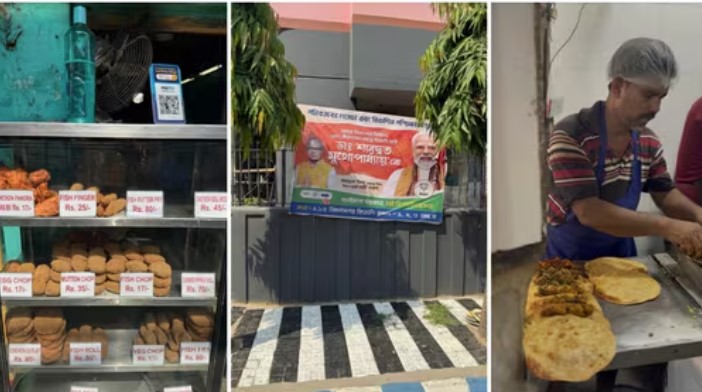
In West Bengal elections, food politics has taken centre stage as voters debate non-veg rights, and identity amid competing narratives by TMC and BJP.
Amid the West Bengal election chatter, one thing that has emerged as the biggest talking point is non-veg — with chief minister Mamata Banerjee claiming that the Bharatiya Janata Party will make access to non-vegetarian food difficult for Bengalis if voted to power. The BJP, on the other hand, has been going all out to deem these claims baseless, so much so that one of its candidates was recently seen campaigning with a fish.
Against this backdrop, conversations across some of the city’s most popular eating hubs - from biryani outlets and kathi roll joints to iconic cabins - have increasingly shifted towards an unusual political question: food.
Food as identity
For many in Bengal, food is inseparable from identity. Maach and maangsho (fish and mutton) are more than just food. They are an emotion for Bengalis. At one biryani outlet, S Syed Qamar Ahmed, a native of Bihar who frequently visits Kolkata, framed the issue as one of personal freedom.
He said food choices ultimately depend on individuals and not governments, arguing that no authority should dictate what people eat. While acknowledging political debates around the issue, he suggested that the larger concern for voters remains peace and coexistence across communities rather than dietary restrictions alone.
Ahmed added that governments should focus on maintaining harmony and ensuring that citizens from all religions and backgrounds feel secure.
“The present government is good. BJP talks about good governance too, but sometimes their workers provoke people’s feelings - whether Muslim or any other community. The government itself is not bad everywhere, but emotions get stirred up,” Ahmed opined.
When asked if he would like a change in government, he replied, “For people of every religion and caste, whichever government comes should bring peace, harmony and safety. It would be better if politics does not disturb communal harmony.”
Fire where there's smoke?
Inside another bustling outlet, a staff member who requested anonymity reflected a more cautious mood - one that mirrored several conversations heard across the city.
The worker said Mamata Banerjee's remarks appeared linked to developments in other parts of India, where tensions over vegetarian and non-vegetarian food have occasionally surfaced. According to him, such incidents elsewhere make some people in Bengal wary of similar divisions emerging locally.
He described a lingering concern that politics centred on food habits could deepen social divides, even if immediate restrictions seemed unlikely.
“Non-vegetarian food is something very dear to Bengalis. Around 90 per cent of India’s population is non-vegetarian - so how can anyone stop people from eating? Bengal’s machh-bhaat [fish and rice] is famous,” he said.
When asked whether he felt Mamata Banerjee’s claims had some basis, he said, “Yes, what Mamata ji is saying is based on what we are seeing in other states - during festivals there are fights over vegetarian and non-vegetarian food, attempts to stop people, and forceful behaviour. Violence over food choices is happening outside West Bengal, so from that perspective what she is saying is correct.”On whether he was happy with the current government, he replied, “Yes, it is a very good government. Across India, you will find the most peace in West Bengal.”
Fear, choice and political preference
For Shehnaz Begum, a Kolkata resident I met outside an eatery, the debate was less about bans and more about stability.
Begum said people should remain free to choose what they eat, adding that conflict arises only when communities stop coexisting peacefully. While she rejected the idea that non-vegetarian food would suddenly disappear, she felt a change in government could make everyday life more difficult if tensions increased.
Expressing support for continuity, she said Mamata Banerjee's leadership appealed to her because she believed the current government attempts to “take everyone along”, though she also hoped governance and development would continue improving.
Business owner's measured assessment
At Sankar Cabin, owner Ram Krishna Gharai offered a quieter, more measured assessment. He said the TMC might return to power but with a slightly reduced seat tally.
He said he did not expect a dramatic political shift in this election, though he stressed that whichever government comes to power must prioritise people’s needs.
Across Kolkata, reactions revealed neither widespread alarm nor outright dismissal of the chief minister’s claim. A bike taxi rider told me that he feels the non-veg debate is not something locals are particularly concerned about. He said it is ultimately up to the people what they want to eat and, in a state like West Bengal where non-veg is a staple, no party or its offshoots will be able to impose anything.
How BJP is countering the narrative
Among those countering the narrative was Sharadwat Mukherjee, the BJP candidate from Bidhannagar, who was seen campaigning with a fish - an image that quickly drew attention this election season.
Explaining the move, Mukherjee said the campaign aimed to respond to what he described as opposition claims that a BJP government would turn West Bengal into a vegetarian state, depriving Bengalis of fish, a cultural staple.
Referring to statements made by chief minister Mamata Banerjee, he said his campaign sought to counter that narrative directly. Mukherjee noted that although he himself is vegetarian, fish remains central to Bengali identity and nutrition, and therefore campaigning with it was meant to reassure voters.
He added that he did not anticipate the campaign visuals going viral, but said it reflected how elections in Bengal increasingly revolve around emotional narratives rather than debates on infrastructure, education, investment or industry. Criticising the state government, he argued that welfare politics has overshadowed long-term development priorities.
“Campaign is basically to set my narrative and, on the other hand, to counter the narratives already issued by the opposition. A couple of days before I started my campaign, there was a very vociferous campaign by the opposition, especially by the chief minister Mamata Banerjee, that once BJP comes, the entire state of West Bengal will be converted into a vegetarian state and we will never be able to enjoy fish, which is one of the staples in Bengal. So I decided that this was the right time to counter that — perhaps it was a boiling issue at that time,” Mukherjee said, speaking to hindustantimes.com.
“So, I decided to campaign with fish. Though I am not a keen fish eater — I am basically an eggetarian — many people in my family do eat it. We are part of Bengal, so obviously Bengalis enjoy fish, and fish is one of the finest non-veg items health-wise. It is a great source of protein. So, there is nothing wrong in campaigning with fish. I never knew it would go viral,” he added.
He said he believes such narratives set by political parties are “useless things which turn people into something they shouldn’t be”.
“It is very sad that in Bengal, the diet of a person has become an election issue. In other states like Maharashtra, Gujarat and Tamil Nadu, debates are usually about investment, education and development,” Mukherjee added.
Unfortunately, our chief minister has long forgotten that there is something called infrastructure — taxpayers’ money goes into infrastructure, education, health and industry. But she is a dole distributor… interested only in doles, which in the long run will not support the economy or improve the state of affairs in Bengal. This needs to be corrected,” he said.
If election rallies amplify political slogans, Kolkata's corners tell a subtler story. Here, voters debate the future between mouthfuls of biryani - weighing narratives carefully, expressing preferences cautiously, and revealing an electorate that remains attentive, but measured in its political voice.


comments


Other categories
Recent Comments