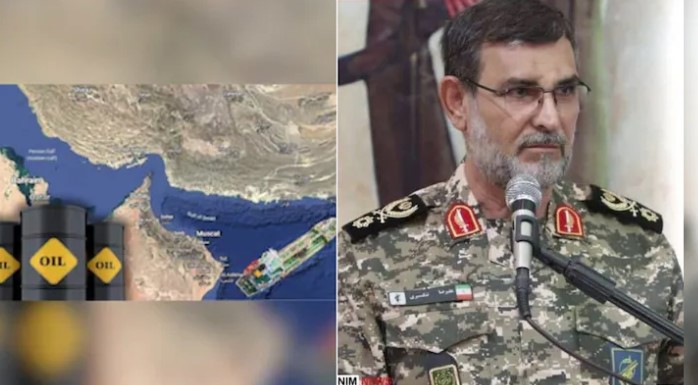
Israel claimed Thursday it had killed Alireza Tangsiri, the commander of Iran's naval forces and the man behind the Strait of Hormuz blockade that has led to a global oil and gas supply crisis.New Delhi:
Israel claimed Thursday it had killed Alireza Tangsiri, the commander of Iran's naval forces and the man behind the Strait of Hormuz blockade that has led to a global oil and gas supply crisis.
Tangsiri's killing, the US will hope, will help ensure oil and gas transiting the Hormuz returns to pre-war levels, easing pressure not only energy markets and prices but also on Donald Trump.
The President faces growing criticism back home over rising fuel prices and for dragging the US into another apparent 'forever war', with his approval ratings sinking to its lowest since he took office a second time.
The Times of Israel said Tangsiri was killed in an airstrike in the port city of Bandar Abbas.
Israel forces had been ordered by Prime Minister Benjamin Netanyahu to step up attacks on Iran military targets ahead of a possible ceasefire announcement this weekend.
Neither Iran nor the IRGC, its elite military force, has responded as yet.
When the war began Feb 28 much of the focus was on Tehran's asymmetric warfare model that involved firing mass-produced, cheaply-made drones to force Israel and American air defences (used by other Gulf nations) into a costly interception game.
Since then, though, the spotlight has shifted to the Hormuz.
Tangsiri's death unlocks Hormuz?
This is unclear but unlikely, given the multi-layered command structure on which the Iranian military is based. The deaths of Supreme Leader Ayatollah Ali Khamenei - on Day 1 of the war - and his right-hand man, national security chief Ali Larijani days later underscores that point.
Replacements for Khamenei and Larijani were swiftly announced and there has been no apparent let-up in Tehran's retaliatory strikes since. After Larijani's death Foreign Minister Abbas Araghchi stressed the deaths would not set back war efforts.
Araghchi told Al Jazeera the command structure is institution and not individual-based, meaning there are multiple back-ups and succession plans in place.
"I do not know why the Americans and the Israelis still have not understood this point: The Islamic Republic of Iran has a strong political structure with established political, economic, and social institutions," he said.
The reference was to the Iranian strategist Mohd Jafari's 'mosaic defence' doctrine.
This enables Iran to decide when and how the war will end," the Foreign Minister had said.
Does this mean anything for India?
The world's third largest energy consumer, its most populous country, and its fastest growing major economy, India relies heavily on exports to meet its crude oil needs.
Most estimates suggest India needs 5.5 to six million barrels of crude dAILY
Pre-war, India imported around half that - 2.1 and 2.6 million barrels - from Gulf nations like Iraq, Saudi Arabia, the UAE, and Kuwait. Shipped via the Hormuz, this worked out to around 40 per cent of crude imports of 4.8 to five million barrels per day.
Re-opening the Hormuz is critical for India's long term economic health.
Harvard professor and former IMF Chief Economist Gita Gopinath told NDTV this week: "Even if oil were to average say only US$85 for the rest of the year, that would shave off about half a percentage point from India's growth," she said, "If it were to average closer to US$100, we're talking about almost one percentage point being impacted. So it's already consequential."
The government has said it is diversifying oil and gas import sources - expanding the basket of 27 suppliers to 41, including the US - and that it has sufficient strategic reserves.
But long-term disruption does not bode well for the world's fastest growing major economy.
The Strait of Hormuz
The strait is a narrow waterway, no wider than 33km, through which a fifth of the world's energy trade, i.e., an estimated 20-25 million barrels daily, is shipped and over which Iran exerts near-complete geographical control.
Tehran's blockade of the Hormuz - backed by an 'underground missile city' on Qeshm Island stocked with anti-ship missiles and naval drones - disrupted tanker traffic by an estimated 95 per cent and sent benchmark Brent crude prices soaring to above US$100 per barrel. It also affected crude oil and gas supplies to India, China, and other Asian nations.
That blockade was reportedly engineered and enforced by Tangsiri.