


Kashmir deserves leaders who acknowledge the past, own their role in its tragedies, and help build a politics that protects the peace as fiercely as it defends opinions
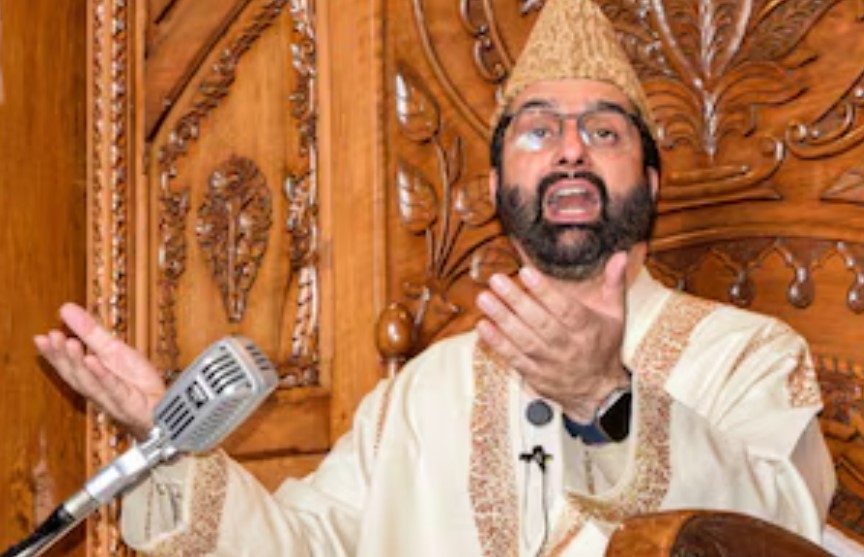
When Mirwaiz Umar Farooq announced on X that he was being “pressed by authorities" to change his profile designation from “Hurriyat Chairman", he framed the moment as an assault on free expression, as a yet another instance, he suggested, of a shrinking public space in Kashmir. He called the choice before him a Hobson’s choice, implying coercion without alternatives. What the post clearly avoided was the far heavier history attached to the designation he insists on carrying, that of the Hurriyat Conference, an umbrella separatist organisation that, since 1990, has fused secessionist politics with a cycle of violence that hollowed out Kashmir’s civic life, wrecked its education system, normalised shutdowns, and pushed thousands of young men toward the gun under a romanticised, utopian promise of Azadi.
To understand why the state finally moved to ban Hurriyat’s constituents, and why Mirwaiz’s plea rings of sheer hypocrisy, one must return to the beginning. Hurriyat Conference emerged in the early 1990s as militancy exploded across the Valley. It was presented as a political platform that was an “alternative voice" claiming to represent so-called Kashmiri aspirations. In practice, it functioned as the political superstructure of an armed movement. While terror groups pulled the trigger, Hurriyat provided the slogans, calendars, shutdown calls, and moral cover. The separation between “politics" and “violence" was always rhetorical and never real.
From the outset, Hurriyat’s strategy relied on cyclical disruption. Protests would be called, followed by shutdowns, then came the violence on the streets. Schools would close “temporarily," often for weeks, and even months. Examinations were postponed; academic calendars were shredded year after year. Each killing, whether by militants, security forces, or in crossfire was converted into a mass mobilisation event. Stone pelting was reframed as “resistance." Funerals became recruitment grounds. The Valley learned to live by protest calendars rather than academic timetables. An entire generation grew up measuring time not by semesters but by strikes.
The human cost of this politics was immense and shattering. Education that was once Kashmir’s most reliable ladder out of poverty was repeatedly sacrificed at the altar of symbolic defiance. Schools were burned, teachers threatened, and students intimidated into absence. Political opponents were silenced through threat, intimidation and assassinations. Tourism collapsed during prolonged shutdowns. Local businesses bled. Families were trapped between fear of militants and the consequences of confrontation with the state. And yet, Hurriyat leaders rarely paid these costs themselves. Their children studied abroad or in elite institutions. Their lives remained insulated from the street-level chaos they orchestrated.
This asymmetry lies at the heart of today’s generation. Hurriyat’s promise of Azadi was an abstraction that was sustained by grievance, amplified by external encouragement, and weaponised through spectacle. Pakistan was held up as the inevitable destination, its failures and its hand bloodied with terrorism conveniently ignored. The Valley was told to wait, to suffer, to bleed because history, Hurriyat claimed, was on their side.
But history moved on as separatism collapsed under its own weight. As the international environment shifted after 9/11, Pakistan’s deniability vapourised into thin air. Within Kashmir, the fatigue set in. Ordinary people began asking uncomfortable questions. What had decades of shutdowns achieved? Who benefited from perpetual unrest? Why did the same leaders who exhorted sacrifice never seem to make any themselves?
It is against this backdrop that Mirwaiz’s post must be read. By lamenting restrictions on his X handle, he casts himself as a besieged democrat. Yet he continues to invoke a title tied to an organisation whose politics systematically shrank public space long before the state ever did. Hurriyat did not merely oppose Indian authority; it dismantled Kashmiri civil society from within. It normalised the idea that dissent must be disruptive, that the opposition to their utopian ideology must be silenced, that education is expendable, that violence direct or indirect is a legitimate political instrument.
There is also a deeper hypocrisy at play. Mirwaiz now speaks the language of communication, dialogue, and outreach to the “outside world." But Hurriyat’s core ideology rejected precisely those plural, incremental pathways. It delegitimised elections, boycotted institutions, and derided compromise as betrayal. It taught young Kashmiris that engagement was submission and that maximalist demands were the only authentic posture. Having helped build that worldview, Mirwaiz now seeks exemption from its consequences by continuing to trade on the symbolism of a banned organisation while avoiding the accountability that comes with it.
The ban on Hurriyat’s constituents, including the Awami Action Committee, did not emerge in a vacuum. It has followed years of financial probes, terror-funding cases, and evidence of coordination with violent networks. To reduce this to an issue of a social media handle is to trivialise the damage wrought over three decades. Free expression is not an abstraction divorced from history; it exists within a moral ledger. Movements that actively undermined freedoms for others, by closing schools, silencing dissenters, and sanctifying violence cannot credibly claim victimhood when the state finally draws red lines.
None of this negates the need for political engagement in Kashmir. Durable peace requires dialogue, representation, and safeguards for civil liberties. But it also requires honesty. The Valley cannot move forward if its most visible figures continue to recycle a utopian ideology that delivers only grief, while recasting themselves as neutral commentators wronged by circumstance.
What makes this moment particularly revealing is the contrast between this rhetoric of grievance and the material changes Kashmir has experienced in recent years. Since the abrogation of Article 370, the Valley has witnessed a steady, if uneven, return of institutional normalcy that is most visible in education and tourism, the two sectors that separatist politics had systematically devastated. Schools and colleges that once existed at the mercy of shutdown calendars have functioned with far greater continuity. Academic years, long treated as expendable collateral in the politics of protest, have regained structure. For a generation that grew up amid uncertainty, this stability has carried more weight than slogans ever did.
Tourism, too, has become an inadvertent referendum on the rejection of the cyclic unrest that Kashmir witnessed for three decades. Record footfalls, sustained seasons, revived local businesses, and renewed employment across hospitality and transport sectors have signalled something deeper than economic recovery. They reflect a societal preference that is quiet but decisive for predictability over perpetual agitation. The everyday choices of Kashmiris to reopen shops, send children to school, and engage with a broader economy speak louder than separatist manifestos ever did. In this lived reality, the politics of shutdowns and symbolic defiance has lost both its moral authority and its audience.
It was at precisely this juncture that Mirwaiz Umar Farooq could have chosen a different path. With his religious stature and historical visibility, he was uniquely positioned to guide his followers toward reconciliation by acknowledging the failures of the past and reimagining dissent without destruction. That choice did not require abandoning political positions; it required abandoning the idea that confrontation itself was a virtue. It required telling hard truths to his constituency rather than reaffirming comforting myths.
Instead, Mirwaiz returned once more to a familiar script of the utopian confrontational worldview, repackaged as victimhood. By framing himself as coerced rather than accountable, constrained rather than complicit, he avoids engaging with the deeper question Kashmiris are already asking among themselves, what did this ideology actually deliver? In choosing symbolism over self-reflection, he again asks the people to emotionally invest in an idea whose costs they have already borne with blood, while absolving its architects of responsibility.
This, ultimately, is the central tragedy of Hurriyat’s afterlife. Even as Kashmir tentatively steps away from the politics that consumed it, some of its most prominent figures remain trapped in the language of a past that no longer commands belief. The Valley is slowly changing not because the ideology was subdued, but because people quietly rejected it. And until that reality is acknowledged by those who once claimed to lead the aspirations of the masses, the gap between rhetoric and lived experience will only continue to widen.Kashmir deserves leaders who acknowledge the past, own their role in its tragedies, and help build a politics that protects the peace as fiercely as it defends opinions. Until that happens, invocations of Hobson’s choice sound less like a principled resistance and more like an attempt to escape history, without ever apologising to the people who paid its price.


comments


Other categories
Recent Comments