


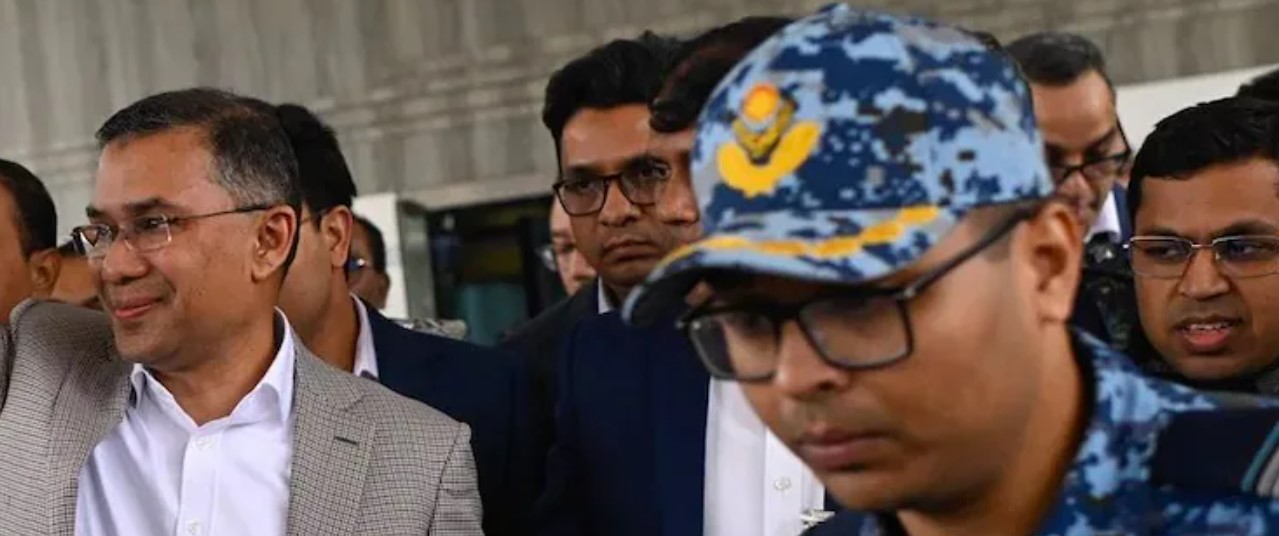
His return comes at a time when his country is at a crossroads, and Rahman could be in a position to give it direction as his party still remains the frontrunner in the February 2026 elections.
New Delhi:
Christmas Day saw the triumphant homecoming of Bangladesh's 'dark prince' - Tarique Rahman, the son of three-time former Bangladesh Prime Minister Khaleda Zia and a central figure in her Bangladesh Nationalist Party - after nearly 17 years in self-imposed exile.
Political 'royalty' by any standard - the 60-year-old is also the son of ex-President Ziaur Rahman - he returned to a country on the boil, after a violent civil uprising in July overthrew Sheikh Hasina, now in exile in India and facing a death sentence, and brought down her Awami League government.
Rahman returned to an ecstatic welcome from lakhs, many of whom walked long distances, some overnight, to line the streets of Dhaka, waving flags and chanting slogans to support the 'prince'. And he returned with echoes of American civil rights activist Martin Luther King's 'I have a dream' speech.
"Like him, I want to say, I have a plan for Bangladesh," Rahman thundered, kickstarting the BNP's campaign for the general election on February 12, an election his mother and he are expected to contest and one, if they win, could see him become the next Prime Minister.
Tarique Rahman, the real 'boss'
Rahman, of course, is no stranger to power.
And he is no stranger to running a country either, if his critics are to be believed.
The 'dark prince', his detractors have often claimed, was the de facto boss from 2001 to 2006, when a coalition led by the BNP and Jamaat-e-Islami Bangladeshi was in power and Khaleda Zia was in Ganabhaban, in the prime minister's chair.
Six kilometres separated mother and son.
Rahman was based out of Hawa Bhaban - a two-floor building once described darkly by one senior official as a 'wind tunnel'. It was, on paper, his office. It was really a shadow PMO.
Diplomats, intelligence officials and party insiders later confirmed, in hushed voices and whispers, that Hawa Bhaban was a parallel, if not the main, seat of power.
In the years that followed the BNP-Jamaat government's fall, and Rahman's self-exile, intelligence and media reports painted grim portraits of the 'prince's rule', including allegations the 2004 grenade attack on Sheikh Hasina, Zia's arch-rival, was planned in Hawa Bhaban.
There are also reports Hawa Bhaban was the nerve centre of an audacious weapons smuggling network that supplied guns and ammunition to the ULFA separatist group in Assam.
End of the line for Rahman
All of that came to a screeching halt between 2006 and 2008 - a period also marked by violent civil unrest as Zia's BNP and Hasina's Awami League squabbled over an election that should have been held by mid-November 2006, i.e., within 90 days of the BNP-Jamaat term ending.
The chaos at the time included a military 'caretaker' government that reportedly curtailed fundamental freedoms and tried to engineer a political landscape without Zia or Hasina.
Eventually that failed and an election was held in 2008 that the Awami League won.
Arrest, exile, and return
Rahman, meanwhile, was arrested by the caretaker government in May 2007 and held for 17 months on various charges, including corruption, extortion, and money-laundering.
These, and other charges, including colourful descriptions of Rahman as a symbol of 'kleptocratic' politics, have been rubbished by the BNP, of which he is the Acting Chairman.
The BNP has always held the charges are politically motivated.
He was released in 2008 to receive medical treatment in London.
'Dark prince' is home
His return comes with his country at a crossroads. Rahman is widely viewed as the frontrunner in the February 2026 election. The BNP has already collected papers on behalf of Zia - for the Gabtali-Shajahanpur - and Rahman will contest his mother's Sadar seat, which she held from 1991 to 2018.
Rahman has positioned himself and the BNP as a 'champion of democracy' and the return to an elected government. Earlier this month, he said, "Only democracy can save us... and it is you, each and every member of the Bangladesh Nationalist Party, who can strengthen the foundation of that democracy."


comments


Other categories
Recent Comments